By Anil Pandey — Founder, Chairman & Managing Director, Plexus Digitals; Chief Advisor, Plexus StratWorks
A few months ago I sat with the owner of a mid-sized engineering unit outside Kanpur. Good business. Real order book. Third generation. He walked me through his floor with obvious pride, and then, over tea, he said something I have not been able to put down since.
"I know I'm losing money somewhere," he said. "I just don't know where."
He was not being careless. He was being honest. He had no dashboard, no analyst, no one to ask. His CA closes his books. His machinery vendor sells him machines. Nobody in his world is paid to tell him the truth about his own business.
That conversation is the reason Plexus StratWorks exists.
The gap nobody is pricing for
India has roughly 7.86 crore MSMEs. Together they produce close to a third of our GDP and something like 45% of our exports. Uttar Pradesh, where I live and work, is second in the country by MSME count.
These are not small numbers. These are the numbers of an economy.
And yet, ask yourself who is actually advising these businesses. The large consulting firms are structurally priced for corporations — an engagement that makes sense for a listed company is absurd for a firm doing ₹80 crore. Software vendors will happily sell tools, but a tool is not a decision. And the AI industry, so far, has been talking almost exclusively to enterprises that already employ data scientists.
So the businesses that carry the most economic weight per rupee of support get the least support. The advice gap is not a market failure at the edges. It is the market.
What makes it more urgent is that the ground has just shifted. The April 2025 revision to MSME thresholds — small enterprises up to ₹100 crore turnover, medium up to ₹500 crore — pulled a whole band of serious, ambitious, professionally-run firms into the MSME bracket. These are companies with the scale to invest in strategy and AI, and nowhere good to buy either.
Why agentic AI changes the arithmetic
For most of my 33 years in this industry — across Accenture, HCL, Wipro and Enzen — good advice has been expensive because good advice was scarce human hours. A partner's time, an analyst's time, a specialist's time. That cost floor is precisely why the MSME never got served.
Agentic AI moves that floor. Not because it replaces judgement, but because it collapses the cost of everything around judgement.
Consider what an advisor actually does before they say anything useful. They benchmark you against peers. They comb through scheme eligibility and credit options. They scan competitors, map demand geographies, check regulatory exposure. Weeks of work, most of it structured, most of it repeatable.
That work is exactly what a well-built agent does well. Not a chatbot — an agent: a system that takes a task, uses tools, produces a concrete artefact, and hands it to a human who decides.
At Plexus we have built seventeen of them, grouped into five squads that map to what a business actually needs:
Diagnose — an honest 360° read on finance, operations, market and digital maturity.
Fund — credit readiness, valuation, and every government scheme you are actually eligible for.
Enable — the right-sized technology stack, and automation of the work that shouldn't need a human.
Target — where the demand is, which channels convert, what competitors are doing.
Govern — a live console, a monthly board brief, and regulatory watch.
The advisor stays in the room. The agents remove the reason the advisor used to be unaffordable.
Eight sectors where this would land hardest
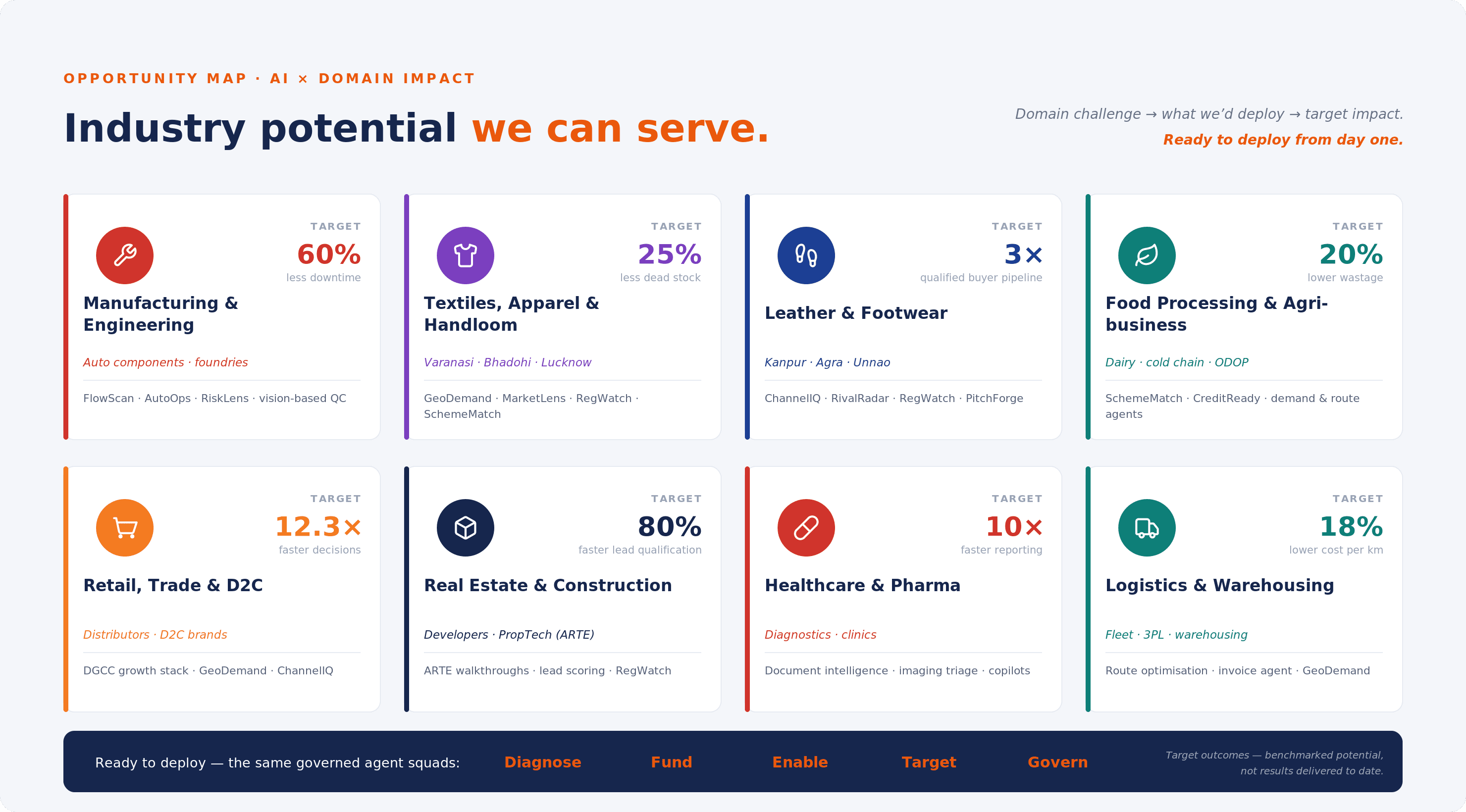
We recently mapped where this combination — domain depth plus agentic AI — would create the most value in the Indian MSME landscape. Eight sectors stood out, and I want to be specific rather than gesture at "industry 4.0":
Manufacturing and engineering — unplanned downtime and quality rejects, with no live view of shop-floor data. Predictive maintenance and vision-based QC are mature technologies; they are simply not reaching the units that need them.
Textiles, apparel and handloom — Varanasi silk, Bhadohi carpets, Lucknow chikankari. Demand swings produce dead stock; export paperwork locks up working capital. Demand forecasting and compliance agents attack both.
Leather and footwear — Kanpur, Agra, Unnao. The problem is not craft; it is buyer discovery abroad and tightening ESG norms.
Food processing and agri-business — spoilage, cold-chain gaps, and missed FSSAI or scheme deadlines that quietly eat the margin.
Retail, trade and D2C — inventory guesswork, and marketing spend with no honest read on what converts.
Real estate and construction — long sales cycles and weak site-visit conversion, where immersive walkthroughs let a buyer experience a building before it exists.
Healthcare and pharma — documentation and administrative load crowding out the actual work.
Logistics and warehousing — route cost, idle fleet, invoice disputes, and no live cost-per-kilometre view.
Notice what these have in common. None of them is an AI problem. All of them are business problems that AI happens to be unusually good at.
Now the part most companies leave out
I could end here, and you would be forgiven for assuming we have done all this a hundred times.
We have not. StratWorks is a new practice, and I would rather tell you that plainly than have you discover it later.
What I will claim is this: the capability is not new, even if the practice is.
Our platforms are live, not on a roadmap — ARTE for spatial and immersive work, DGCC as our cognitive command centre. The seventeen agents are built, not sketched. Our AI training runs today, delivered with AV Academy to corporate and real-estate clients. And the advisory bench is real: thirty-three years of enterprise transformation, a CXO team, and a founder who will personally be in the room precisely because we are early.
The numbers we publish for each sector — 60% less downtime, 25% less dead stock, 3× the qualified buyer pipeline — are targets, benchmarked from comparable AI implementations worldwide. They are not results we have delivered. Anyone in this industry can dress up a benchmark as a case study, and plenty do. I would rather earn the case study.
What I am actually asking for
If you run an MSME in one of these sectors, the honest offer is an AI readiness session. No deck-driven pitch. We look at where the money is leaking and I tell you what I think — including, if it is true, that you do not need us yet.
And if you are someone whose network runs through India's business community — an investor, an association, a fellow founder — I am asking for introductions, not endorsements. Send us the sceptics. The businesses that have been sold vapourware before are exactly the ones who will notice the difference.
That engineering owner outside Kanpur was right. He was losing money somewhere. It took a fortnight to find most of it, and none of what we found required a machine learning breakthrough — it required someone to look, with the right tools, and then tell him the truth.
There are 7.86 crore businesses in this country waiting for someone to do that.
About the author
Anil Pandey is Founder, Chairman & Managing Director of Plexus Digitals and Chief Advisor of Plexus StratWorks, the firm's MSME advisory practice. He has spent 33 years in enterprise technology across Accenture, HCL, Wipro and Enzen, and was a panellist at the World Innovation Summit (WISE 2022). He writes from Lucknow.
Ready to Grow?
Let's Build Your Digital Growth Engine
Join 200+ brands using Plexus Digitals to command their digital growth with AI, Metaverse, and next-generation marketing.